the end of the world
I woke this morning, as did we all, to news of more bombings in Lebanon, more rockets being fired into Israel, more uranium enrichment in Iran, more floods in India and Ethiopia, a volcano about to erupt in the Philippines, and a breakdown in oil production in Alaska. All we need now is news that Celine Dion is releasing a new CD and I will know it’s the end of the world.
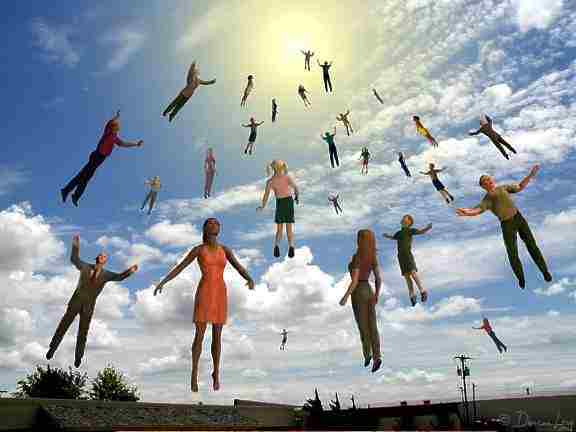
My friend Jay called yesterday afternoon to read me parts of a “Rapture web site” that has created a “Rapture Index” much like the stock market indexes to measure how immanent the rapture is (my choice not to provide the link – I don’t want to encourage them). They give points for everything from debt-trade ratios to natural disasters to foreign governments to the Anti-Christ (there’s Celine Dion again), creating a number that’s supposed to show how close we are to Jesus’ return to rescue the faithful and leave everyone else behind to read Tim LaHaye novels.
I had email from another friend who pointed me to Bill Moyer’s new PBS series
, specifically his conversation with Pema Chödrön, a Buddhist teacher and writer from Cape Breton, Nova Scotia. In their conversation, Chödrön made a distinction between pain and suffering:
BILL MOYERS: The Buddha talked about the truth of suffering
PEMA CHÖDRÖN: Yeah.
BILL MOYERS: What do you think he meant by suffering? And what do you Buddhists mean by suffering?
PEMA CHÖDRÖN: Suffering?
BILL MOYERS: Yes.
PEMA CHÖDRÖN: Well, that's a complex question, but it doesn't mean that we could be free of that, if fire burns you, it won't hurt. If you get cut, it won't hurt. It also doesn't mean that if someone you love very dear, deeply, dies you won't feel sadness. And it doesn't mean that bad things won't happen to you anymore, you know? It doesn't mean that you won't have your personal tragedies and catastrophes and crisis. And it also certainly doesn't mean that you could avoid planes flying into the towers, you know? Do you know what I'm saying?
BILL MOYERS: I do know about that because—
PEMA CHÖDRÖN: So it's all about that the end of suffering has to do with how you relate with pain. Let's distinguish just for semantics, the difference between, let's call pain the unavoidable and let's call suffering what could what could lessen and dissolve in our lives. So, if there's sort of a basic phrase you could say that it isn't the things that happen to us in our lives that cause us to suffer, it's how we relate to the things that happen to us that causes us to suffer.
My friend Kaye wrote in response: “Loss hurts. Suffering is different. Refusing to approve of suffering, refusing to be resigned to suffering is something we see too seldom. It's something that requires us to be our best selves. We all know how hard that is.”
Growing up Baptist means I got my share of Rapture stuff. It never really made sense to me because it seemed more about escape from pain than it did hope in the midst of suffering. What I heard was, “We’re all going to get out of here before it gets really bad because Jesus loves us; everyone else is screwed.” Funny – the Christians I knew growing up in Africa, who lived most all of their lives in poverty and pain never talked that way. The Rapture makes sense mostly in American suburbs, where we live in fear of losing our SUVs. If Jesus is as angry as the Rapture Rowdies say he is, I would expect the suburbs to be the first targets.
If God is Love and Jesus is the best human picture of that love, why would God unfold the whole story of Creation to bring it to a surprise ending of vengeance? If the Christian Church is the Body of Christ – the continuing incarnation of God’s love – why would Jesus come to pull us all out of here so we could all sit back and watch everyone else writhe in pain and despair? If there is a wideness in God’s mercy, a peace that passes all human understanding, and a love that excels all others, why are we looking to the future as if the ending were going to be directed by Wes Craven or John Woo? When we see how well we have solved problems in our world by responding to violence with violence, can’t we assume God is smarter and more creative than we are?
I wonder if Garrison Keillor was thinking on some of these things when he included Stanley Kunitz’ poem on
today:
Both the present and the future call us to respond with a mixture of wonder, creativity, tenacity, and compassion that can't be carried in a fist. Maybe it is the end of the world. Maybe not. Before the credits roll, let us pray for strength to be our best selves rather than looking to the sky for an escape hatch.
Peace,
Milton